
In a CT department running contrast studies all day, the injector is more than a pump. It sets the pace of room turnover, accounts for a large share of the disposables budget and, when it fails, decides how long the queue in the waiting room gets. Houston hospitals and imaging centers buying a replacement or an extra unit tend to face the same five decisions, and this guide takes them in order. For repair and equipment sales across the area, see our medical equipment repair and sales page for Houston.
Decision 1: syringe-based or syringeless
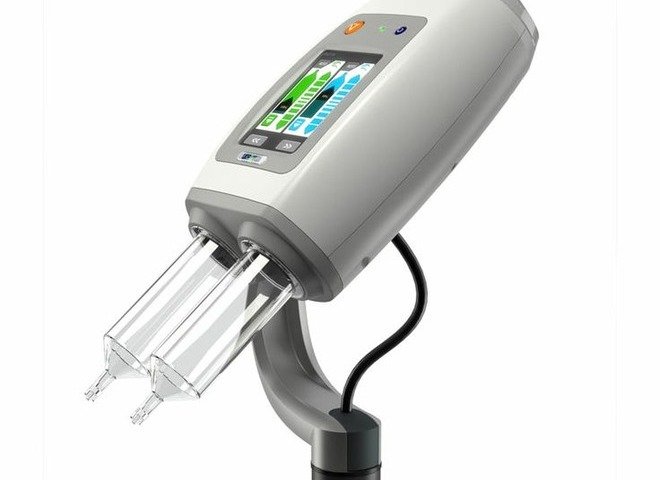
A dual-syringe injector needs its syringes loaded and filled between patients. A syringeless system such as Bayer's MEDRAD Centargo draws contrast and saline from bottles or bags through a day set labeled for 24 hours, with only a single-use patient line changed for each patient, and its sensors detect empty containers and air before the patient line (Bayer Centargo specifications). For a department doing many contrast studies a day, fewer steps between patients can mean faster turnover and less contrast thrown away in part-used syringes. For a lower-volume site, a dual-syringe injector is simpler and usually costs less to buy.
Decision 2: cost per patient, not purchase price
Over the life of an injector, disposables can cost more than the machine itself. Before comparing quotes, fill in a simple worksheet for each option using your own volumes and your supplier's prices.
| Cost item | What to ask | Notes |
|---|---|---|
| Syringes or day sets | Price, and how many patients or hours each one covers | Follow the product labeling, not habit |
| Patient lines | Price per patient | Needed with every system |
| Contrast waste | How much is left in each syringe or bottle | Bulk use only within labeling and your facility's policy |
| Service | Preventive maintenance cost and typical repair costs | Ask which parts are still available for that version |
| Downtime | How many studies you lose per day out of service | Highest in departments with a single injector |
Multiply the per-patient figures by your yearly volume and add service. The option with the lowest purchase price is not always the cheapest over five years.
Decision 3: standardize across your sites
Many Houston health systems run CT rooms across a campus or across town. Running the same injector model everywhere means technologists can float between sites without retraining, one set of protocols can be shared, and one stock of disposables and spare parts covers every room. If you already have a model that works well, buying another of the same version is often the simplest choice, even when a newer model is on the market.
If you are moving to a new model, phase it in rather than switching every room at once. Start with one room, build and test the protocols there, train a core group of technologists who can coach the others, then roll the model out room by room while the old injectors stay available as backups.
Decision 4: capture the injection data
It helps to record what was injected with each study: volume, flow rate, peak pressure and any alarms. Some injectors send that data on directly. Centargo, for example, lists interfaces for RIS, Modality Worklist and PACS, and scanner-injector links can save injection parameters with the patient record (Healthcare in Europe). If you track contrast use or review extravasations, ask which data the injector can export, and in what format, before you buy.
Decision 5: plan for downtime
Storms on the Gulf Coast bring power interruptions, and an injector that loses power mid-injection, or takes a surge, needs checking before it goes back into service. Put injectors on the same protected power as the scanner where your facility allows, keep a spare stock of disposables, and know whom you will call for repair. In a department with one injector, decide in advance how contrast studies will be handled if it fails: moved to another room, rescheduled or covered by a backup unit.
Extra checks for a used injector in heavy use
A used injector that will run all day deserves a closer look than one bought for occasional studies. Ask for:
- The injection count or usage history, if the injector logs it, and the error log.
- Records of the last preventive maintenance and of any drive or motor repairs.
- A demonstration at the highest flow rate your protocols use, with pressure limiting tested.
- The condition of the head, its mounting arm and its locks, which take the most handling in a busy room.
- The touchscreen and console, checked for dead spots and cracked housings.
Our checklist of safety features to test on a used CT injector goes through each check in more detail.
Delivery and service in Houston
Houston is within about 300 miles of our Garland headquarters, inside our regular service area. Our CBET-certified engineers respond in under 8 business hours, and installation includes flow, volume and pressure checks, an electrical safety test and staff training. Our reconditioned equipment carries a 90-day warranty, and when you replace an injector, our retired equipment services can take the old one off your hands. To compare injector types and model families, read our Texas CT injector buying guide; for everything we do in the area, see our Houston service area. We are an independent company and are not affiliated with any injector manufacturer. Call (469) 767-8853 or send us a request with your scanner models and daily contrast volume.






Leave a Comment
Comments [0]
No comments available for this blog.