
A CT contrast injector pushes contrast and saline into a patient's vein at a set flow rate and pressure, timed with the scan. When one fails, contrast studies stop, so most buyers need a dependable replacement quickly and at a sensible price. This guide covers the types of CT injector, the model families you will see for sale, what a refurbished injector should come with, and where to read more for your city. For other equipment we sell, see our medical equipment for sale page.
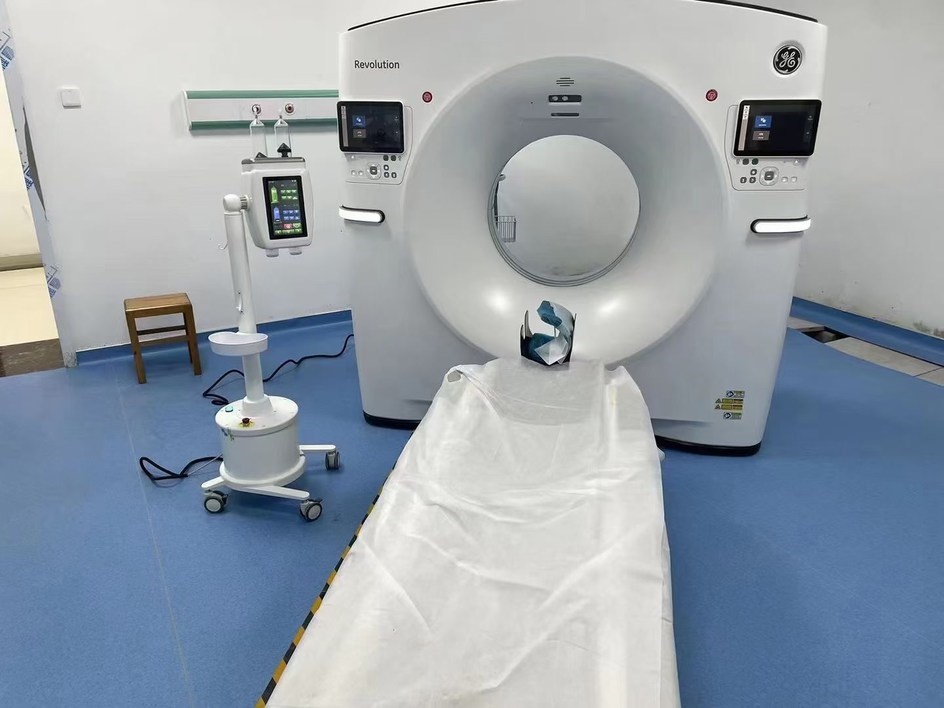
Three types of CT injector
| Type | How it works | Usually suits | Watch for |
|---|---|---|---|
| Dual-syringe | Two syringes, one for contrast and one for saline, filled for each patient or used as the labeling allows | Most CT departments | Syringe and tubing cost per patient |
| Syringeless | Contrast and saline drawn from bottles or bags through a multi-patient set, with a new patient line for every patient | High-volume departments | Day-set rules and staff training |
| Single-syringe | One syringe, no saline flush | Low-volume sites and older installations | No saline flush, which many contrast protocols now use |
What the specifications look like
Two widely used systems show typical numbers. Bayer's MEDRAD Stellant FLEX, a dual-syringe injector, takes 150 mL and 200 mL syringes, injects at 0.1 to 10 mL per second, has a pressure limit adjustable from 50 to 325 psi and supports up to six programmable phases (Stellant FLEX specifications). Bayer's MEDRAD Centargo, a piston-based syringeless system, runs from three 200 mL reservoirs (two for contrast, one for saline), uses a day set labeled for 24 hours plus a single-use patient line for each patient, and injects at 0.1 to 10 mL per second up to 300 psi (Bayer Centargo specifications).
Whatever the model, the pressure limit you set has to respect the lowest rating in the line: the IV catheter, the tubing and any power-injectable port or PICC. UCSF's vascular access guidance, for example, lists many power-injectable PICCs and ports at 5 mL per second with a 300 psi limit (UCSF Radiology). That makes injector settings a protocol decision as much as an equipment one.
Four things to know before you shop
- Your CT scanner: make, model and software version, so you can check whether the injector can be connected for a synchronized start.
- Your volume: roughly how many contrast studies you run a day. Higher volumes make the disposable cost per patient, and syringeless systems, worth a closer look.
- Your protocols: CT angiography and other timing-critical studies usually rely on a saline flush and accurate high flow rates, which rules out basic single-syringe units.
- Your room: whether the injector will stand on a floor pedestal or hang from a ceiling mount, and where the control console will sit.
With those answers, quotes from different sellers become easy to compare like for like.
Model families on the used market
You will mostly see a handful of families for sale: Bayer MEDRAD (Stellant and Centargo), Bracco (the EmpowerCT line), Guerbet (OptiVantage), Nemoto (Dual Shot) and ulrich medical (CT motion, a syringeless design). Within a family, check the exact version, because disposables, software and scanner interfaces change between versions. Before you buy, confirm that disposables for that version are still sold and what they cost per patient. That cost lasts as long as the injector does, and over a few years it can outweigh the purchase price.
What a refurbished CT injector should come with
- A test record showing flow rate, volume delivered and pressure limiting checked against the manufacturer's specifications.
- An electrical safety test record.
- The software version and installed options, including any scanner interface.
- Every part of the system: injector head or heads, pedestal or mount, console and the cables between them.
- A list of the parts replaced, and the warranty in writing. Our reconditioned equipment carries a 90-day warranty.
Buying in your part of Texas
Each city guide takes a different angle, so read the one that matches your situation, wherever you are.
- Dallas–Fort Worth: CT injector for sale in Dallas covers matching the injector to your scanner and room, with same-day installation available across DFW.
- Houston: CT injector for sale in Houston looks at busy departments: throughput, cost per patient and downtime.
- Austin: CT injector for sale in Austin walks a new imaging center through the policies to write before its first contrast scan.
- San Antonio: CT injector for sale in San Antonio is a hands-on checklist of safety features to test on a used injector.
After the sale
Injectors need preventive maintenance on the manufacturer's schedule, and repair when a head, a drive or the console fails. Our CT injector repair guide covers common faults and service. Our CBET-certified engineers respond in under 8 business hours within about 300 miles of our Garland headquarters, with same-day visits across Dallas–Fort Worth. We are an independent company and are not affiliated with Bayer, Bracco, Guerbet, Nemoto or ulrich medical.
Common questions
Will a CT injector work with any CT scanner?
For manual starts, generally yes: the technologist starts the injection and the scan. A synchronized start from the scanner console needs a compatible interface on both the scanner and the injector, which our Dallas guide explains.
Should we buy new or refurbished?
New makes sense when you want the latest version, a syringeless system or a manufacturer service contract. Refurbished fits when budget matters and the model's disposables and parts remain available.
How do we get a quote?
Tell us your CT scanner model, roughly how many contrast studies you run a month, and whether you prefer syringes or a syringeless system. Call (469) 767-8853 or send us a request.





Leave a Comment
Comments [0]
No comments available for this blog.